Textile guide · Cotton bedding
BOVI Percale: Understanding the Crisp Cotton Weave
A cool, crisp sheet begins with a simple pattern: one thread crossing over another, then passing beneath it. That plain-weave structure gives percale its distinctive matte finish and fresh hand. Yet weave is only part of the story. Cotton fiber, thread count, yarn preparation, finishing, and the climate of a bedroom all shape how a sheet feels night after night.
A small pattern with a clear signature
Run a hand over a percale sheet and its character is often apparent before the bed is made. The surface feels dry and smooth rather than glossy; the fabric tends to fall with a clean, restrained drape. It may bring to mind a freshly laundered shirt or the cool side of a pillow. This impression comes in large part from the weave: a regular grid in which each yarn alternates over and under its neighbors.
That pattern is known as a plain weave. It is among the most fundamental structures in textiles, used in materials that range from lightweight cotton cloth to sturdier canvas. In percale bedding, the plain weave is usually made with relatively fine yarns and a sufficiently close construction to create a balanced, even fabric. The result is not a special fiber, but a way of arranging fibers into cloth.
“Percale” is commonly used to describe a crisp cotton sheet, although the word alone does not tell the whole story about fiber quality, finishing, or the exact experience a sleeper will have. Two sheets can both be called percale and still feel different. One may be airy and light; another may feel denser and more substantial. The name points toward a family of qualities, not a guarantee that every sheet will be identical.
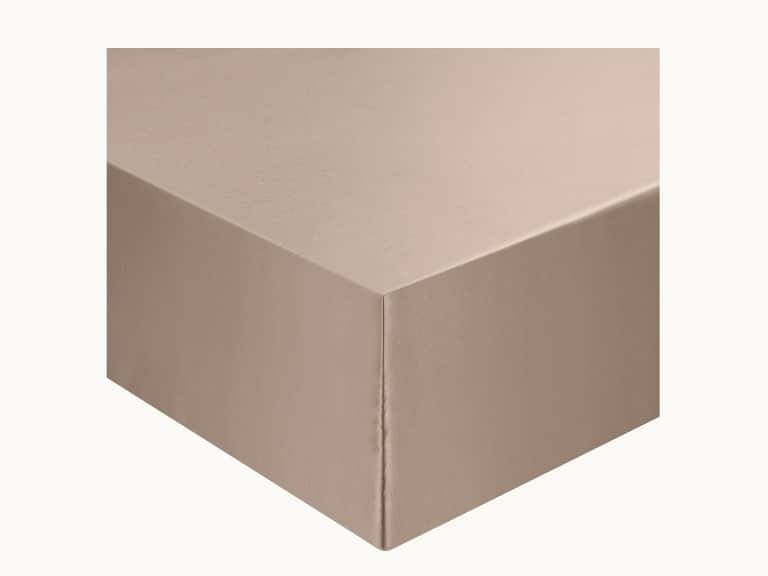
BOVI’s Simply Percale collection offers a useful reference point for understanding this kind of bedding. Its description identifies long-staple cotton, a 400-thread-count percale weave, cool hand, and a subtle piping detail. Each detail tells us something different: the cotton describes the raw fiber, the count provides a construction measure, the weave shapes the surface, and the piping gives the edge a finished outline.
What “one over, one under” means
Imagine the lengthwise yarns in a loom as a set of parallel lines. A crosswise yarn travels across them, passing over one and under the next. The following crosswise yarn reverses that sequence. Repeated across the fabric, the interlacing forms a compact checkerboard structure. In a plain weave, the crossings are frequent and evenly distributed, so the surface appears orderly and the cloth holds together as a balanced sheet.
This differs from a sateen weave, where yarns float over several neighboring threads before interlacing again. Those longer floats can create a smoother, more reflective face and a softer, more fluid drape. Percale’s more frequent crossings generally help produce a matte appearance and a crisper, more structured hand. Neither structure is inherently superior. They simply create different tactile and visual effects.
Weave also influences how a fabric moves and wears, but it is not the only determinant of performance. The quality and preparation of the yarn, the density of the construction, and the finishing applied after weaving all matter. A plain weave made from one cotton yarn may feel quite unlike another plain weave made from a different yarn. Think of weave as the architecture of the cloth: important, visible in the result, but not the entire building.
That architecture helps explain why percale is often associated with a crisp, cool sensation. Its surface does not have the same glossy character as many sateens, and its construction can feel more open and airy than a dense, silky fabric. Still, “cool” is a subjective description. Room temperature, body temperature, humidity, bedding layers, and personal sensitivity all affect whether a sleeper experiences a sheet as refreshing or simply smooth.
Thread count: useful number, incomplete story
Thread count refers to the number of yarns counted within a defined area of fabric, conventionally one square inch. The count combines lengthwise yarns, called warp, and crosswise yarns, called weft. A sheet described as 400 thread count therefore signals a particular density by this measure, but the number should not be treated as a direct scale of softness or quality.
Why not? Because a count cannot identify the cotton variety, the length or strength of its fibers, the way yarn was spun, or the finishing that followed. Nor does it explain whether the fabric feels crisp, supple, heavy, or airy. Two fabrics with the same stated count may be constructed from yarns of different thicknesses and qualities, and may be finished in different ways. The figures provide a clue, not a complete sensory description.
It is also easy to assume that ever-higher counts must mean ever-better sheets. That shortcut can mislead. The practical goal is a cloth whose fiber, yarn, weave, and finishing work together for the intended feel and use. A moderate count in a well-made percale may be more appealing to someone who values a crisp surface than a denser cloth with a different hand. More threads are not automatically more comfortable threads.
BOVI Simply Percale is described as a 400-thread-count cotton percale. That gives readers a point of comparison, but it should be read alongside the other details: the stated long-staple cotton, the cool and crisp character associated with percale, and the restrained single-line piping. In other words, the count is one part of a product description rather than a verdict on its quality.
Why cotton fiber length matters
Cotton begins as a soft mass of fibers around the seeds of the cotton plant. After harvesting and processing, those fibers are spun into yarn and woven into fabric. Their length is one factor in how well they can be spun. Longer fibers can form yarns with fewer exposed ends and, in many applications, a smoother and more even surface. The term “long-staple” refers to cotton with relatively long fibers, though classifications and commercial usage can vary.
Fiber length is not a magic label. It does not by itself establish the exact softness, durability, or environmental impact of a finished sheet. Yarn preparation, weave density, finishing, and care remain important. Yet it gives a useful clue about the raw material and how it may contribute to the fabric’s surface and strength. When a description identifies long-staple cotton, it is reasonable to consider that detail together with the weave and the sheet’s overall hand.
The path from fiber to bedding is a sequence of decisions. Cotton is cleaned and prepared, spun into yarn, arranged on a loom, and woven. The fabric may then be washed, treated, or otherwise finished to achieve a particular appearance and feel. Each stage can refine or change the cloth. This is why a fiber label alone cannot predict every quality a sleeper will notice: the material is transformed through several stages before it becomes a sheet.
In the case of percale, the aim is often a smooth, balanced fabric with a crisp finish. Long-staple cotton can be one ingredient in that outcome, while the plain weave establishes the characteristic structure. If softness is a priority, note that crispness and softness are not opposites. A sheet can feel smooth against the skin while retaining a firm, fresh hand rather than the fluid, almost glossy touch associated with sateen.
Finishing gives the cloth its final character
After the loom, fabric is not necessarily finished. Washing and other finishing processes can influence how it feels, how it drapes, and how it responds to laundering. The words used to describe these processes are not always standardized across brands, so the most helpful information is often a clear description of the actual experience: matte or lustrous, crisp or fluid, lightweight or substantial.
Percale often becomes more relaxed with use and washing. A new sheet may initially feel especially crisp, then soften while retaining more structure than a sateen. This change is a normal part of living with cotton fabric, not necessarily a sign that its basic weave has changed. The rate and character of softening depend on the cotton, the yarn, the finishing, and the care routine.
Care instructions are therefore part of the textile story. Following the manufacturer’s label helps reduce unnecessary wear, especially from excessive heat, harsh detergents, or overcrowding in the washer. Cotton bedding is generally valued for practical laundering, but exact recommendations can differ with construction and finishing. A sheet that is dried gently and stored cleanly may retain its feel and appearance more consistently than one exposed repeatedly to overly harsh conditions.
Small design features matter, too. The Simply Percale description notes a subtle single-line piping detail. Piping is a narrow trim sewn along an edge or seam. It does not determine whether the body of the sheet is percale, but it can give a pillowcase or bedding piece a more tailored finish. Such details are part of the object’s construction and appearance, separate from the fiber and weave that define its basic textile character.
Choosing a sheet for the room you sleep in
A textile is experienced in a particular place, not in a product description. The same percale sheet may feel wonderfully fresh in a warm bedroom and less inviting in a chilly one. Climate, ventilation, mattress protectors, blankets, and the sleeper’s own temperature all influence comfort. Before choosing a weave, consider the conditions in which it will be used and the qualities you notice most when you settle into bed.
Percale may suit people who prefer a matte surface, a crisp hand, and a sheet that feels comparatively light and breathable. It can also appeal to those who like a neat, composed bed rather than a fabric that drapes with a pronounced sheen. Someone who prefers a very smooth, flowing, and lustrous touch may be more drawn to sateen. These are preferences rather than rules, and neither weave guarantees a particular sleep outcome.
It helps to separate immediate touch from longer-term comfort. The first impression may be the coolness of the fabric, while later comfort depends on how the sheet behaves across the night and through regular washing. If possible, evaluate more than the advertised thread count: look for fiber information, weave, care instructions, construction details, and a description of the hand. Those clues together provide a more useful picture than a single number.
Fit belongs in the decision as well. A well-made sheet that does not suit the mattress dimensions can pull loose or bunch, distracting from its fabric qualities. For fitted sheets, compare the mattress size and depth with the product’s stated dimensions. For flat sheets, consider how much coverage and tuck you prefer. Practical construction is not as immediately romantic as a weave description, but it has a daily effect on how bedding works.
How to compare percale with other cotton bedding
Start with the weave, then look outward. Percale describes the plain-weave structure and its familiar crisp, matte character. Sateen describes a different weave structure that commonly produces a smoother, more luminous face. The fiber may be cotton in both cases, so the distinction is not “cotton versus cotton.” It is a comparison of how the yarns are arranged, alongside the choices made in fiber selection and finishing.
Next, check the fiber description. Cotton type and staple length can offer clues, but they should be considered in context rather than as isolated badges. Then read the thread count as a construction measure. Ask whether the number is accompanied by information about the weave, yarn, and care. If the description gives only a large count and no account of material or construction, it may not provide enough information to predict the feel.
Finally, pay attention to the words that describe touch. “Crisp,” “cool,” “matte,” “soft,” “smooth,” and “luminous” each point toward a different sensory quality, though people may interpret them differently. BOVI’s Simply Percale is presented as cool and crisp, woven from long-staple cotton in a 400-thread-count percale construction, with a modest piping accent. Taken together, these details give a clearer impression than any one claim could offer.
Comparing fabric is most useful when the comparison is specific. Instead of asking which sheet has the “best” count, consider whether you want a fresh, structured surface or a more fluid, polished one. Instead of treating softness as a single scale, ask whether you prefer a dry, crisp smoothness or a sleek, draping smoothness. The answers can guide a more personal choice and help make sense of the different language used in bedding descriptions.
A practical checklist before deciding
- Identify the weave. Look for percale or plain weave if you want a matte, crisp character; compare with sateen if you prefer a more lustrous, fluid surface.
- Read the fiber description. Note whether the sheet is cotton and whether the listing gives information about staple length or other material characteristics.
- Put thread count in context. Treat it as one construction detail, not a stand-alone measure of softness, quality, or comfort.
- Consider your room and habits. Warmth, ventilation, bedding layers, and your preference for crisp or draped fabric all affect how a sheet feels.
- Check dimensions and care. Confirm the sheet suits your mattress and that its washing and drying instructions fit your routine.
- Look at finishing details. Piping, hems, and other edge treatments influence appearance and construction, even though they do not change the central weave.
The lasting appeal of a straightforward weave
Percale’s attraction lies partly in its restraint. Its plain weave does not depend on a glossy surface or elaborate visual effect. Instead, it offers a clear textile character: an even, matte face; a composed drape; and a crispness that many sleepers associate with freshness. That simplicity makes the fabric easy to understand, but not simplistic. The final sheet still reflects the cotton, yarn, construction, finishing, and care that brought it into being.
BOVI Simply Percale illustrates how those elements can be read together. Long-staple cotton identifies a fiber characteristic; the 400-thread-count figure describes a measure of construction; percale indicates the plain-weave family; and the single-line piping adds a neat finishing touch. None of these details alone determines whether the sheet will suit a particular sleeper. Together, they offer a more grounded way to judge its intended feel and design.
When comparing cotton bedding, look beyond the largest number or the most polished phrase. Ask what the weave is, what is known about the cotton, how the fabric is finished, and whether the care instructions suit everyday life. Then consider the final question, which is both simple and personal: do you want your bed to feel crisp and freshly made, or smooth and flowing? In that distinction, the character of percale comes into focus.